The cheapest AI subscription is not good value if it cannot be used inside the system where your work happens. Before comparing prices or benchmark scores, test the access path: supported authentication, included usage, rate-limit behavior, and what remains portable if you change providers.
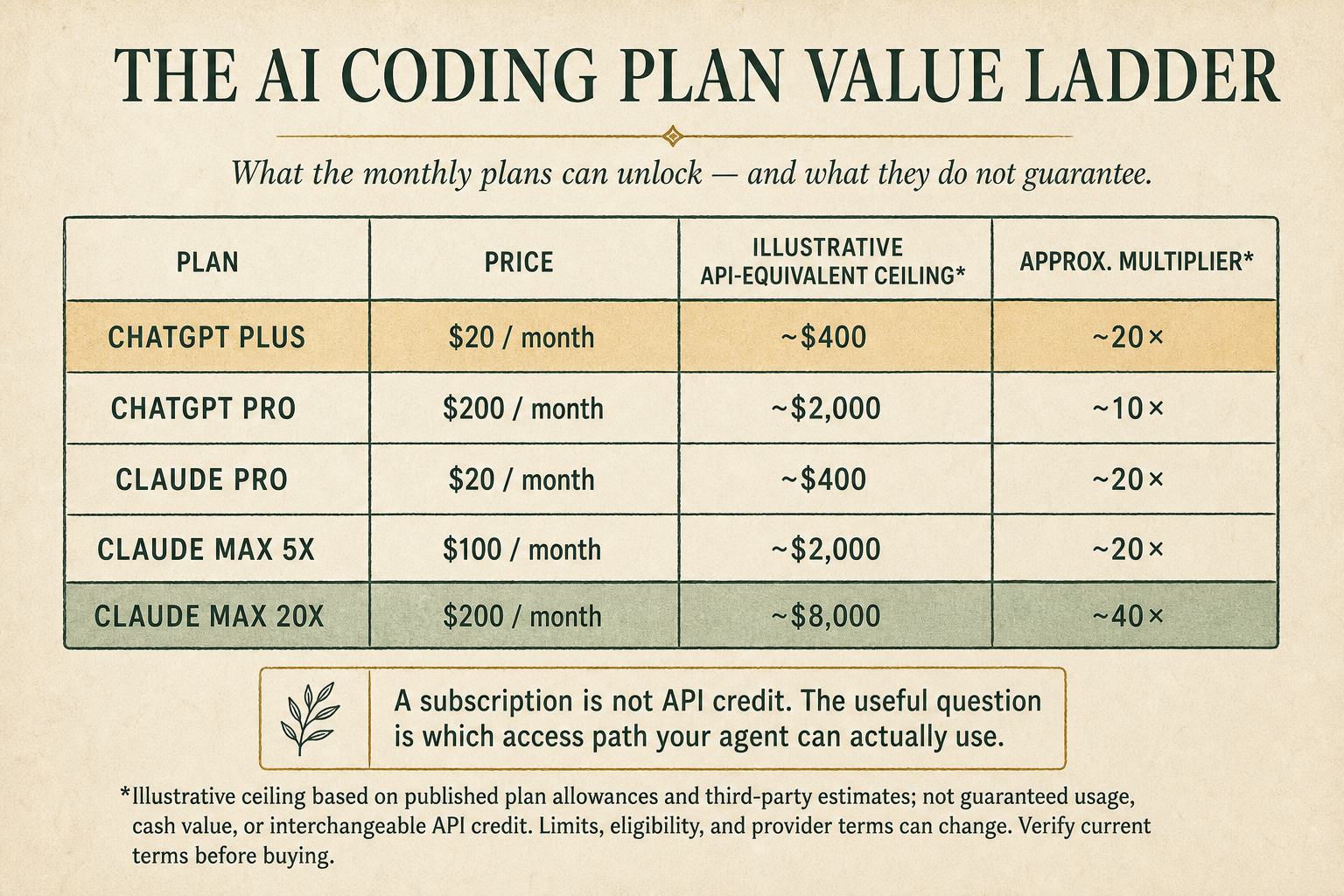
Start with the smallest plan that reliably finishes your work. Let measured usage tell you when to upgrade.
The current OpenAI path in Hermes
As of July 18, 2026, Hermes supports OpenAI Codex through ChatGPT OAuth. That lets an eligible ChatGPT subscription power Codex work inside Hermes without configuring a separate API key for that route.
Our practical starting point is the $20 ChatGPT Plus plan. It is enough to learn the workflow and discover whether Codex is useful for your actual jobs. If valuable work repeatedly stalls on included capacity, the current $100 Pro tier is the next serious step. OpenAI can change plans, credits, and limits, so check the current Codex rate card before buying.
The four-question buying test
- Can this subscription authenticate inside my chosen harness through a supported path?
- Is third-party agent usage included, or billed separately through an API?
- What happens when I reach a rate or usage limit?
- Can I change providers without moving my memory, skills, and project state?
Provider terms, OAuth eligibility, model access, and rate limits change. Treat every comparison as a dated operating snapshot and verify the current provider documentation before buying or upgrading.
Claude built a moat around the wrong thing
Claude was the obvious model leader for many serious builders. But a strong model wrapped in restrictive access is a poor default for an owned agent. Claude Pro and Max are designed primarily for Anthropic's own surfaces: Claude on the web and Claude Code. Anthropic explicitly bills general API usage separately; your subscription is not a pile of portable Claude credits you can freely spend through any third-party harness. See Anthropic's subscription and API explanation.
The current Hermes provider guide does document a Claude Max OAuth path with extra usage credits, so saying Claude subscriptions can never work in Hermes would be false. But it remains a narrower, more conditional route than we want for the default operator, and eligibility or terms can change. Verify the current Hermes Anthropic setup before depending on it.
The economics are the bigger problem. Long Claude Code sessions can consume subscription allowance aggressively. When that lane is unavailable, exhausted, or unsuitable, the fallback is separately metered API usage—and premium Claude tokens get expensive fast. Excellent model quality does not rescue bad operating economics.
Our default recommendation is therefore OpenAI for the main Hermes operator, with Claude used selectively as a specialist. In later Field Notes, we will show how Hermes can delegate bounded reviews, second opinions, and hard reasoning to Claude through Claude Code—then bring only the useful result back—without making Anthropic the prison your whole agent lives inside.
Use routing before buying excess capacity
One model does not need to perform every task. Keep stronger capacity for planning, judgment, synthesis, and consequential verification. Send broad scouting, bulk reading, and suitable mechanical work to less expensive workers when the quality remains acceptable.
Delegation can increase total token use, so this is not a promise of lower aggregate consumption. It is a way to preserve scarce premium attention for work that benefits from it.
The buying rule
- Connect the smallest viable plan to the harness.
- Run real work rather than benchmark prompts.
- Measure where capacity blocks outcomes.
- Improve routing before paying for avoidable premium usage.
- Upgrade only when the next tier removes a constraint worth more than its cost.
Keep your memory, skills, files, and operating rules portable. A subscription should supply capacity, not become the foundation your whole agent depends on.